
Revved / Mobilized
Aim
Reduce unnecessary intensity
- Orientation
- Slower rhythm
- Comfortable breathing
- Steady sensory input
- Supportive connection
WORKBOOK BUNDLE $37 $97 · 14-DAY MONEY-BACK GUARANTEE

Soma Atlas Academy
State First. Technique Second.
Learn to notice what is happening, map your patterns, and build a personal regulation system based on what actually helps you.
★★★★★
4.8 / 5
Customer Rating
2,500+
Customers
United States
Primary Customer Base
Built from a product previously purchased by customers across the United States and rebuilt under Soma Atlas Academy with a clearer system, stronger usability and a more evidence-aware approach.
The Soma Atlas Method
Step 1 · What am I noticing?
Pause and notice your body, energy and attention. Are you tense, restless, heavy, foggy or feeling connected? You do not need to change anything yet.
Use those signals to describe your current state: settled, revved, low or mixed. This is a personal check-in, not a diagnosis.
Ask what you need: less activation, more energy, or more orientation and support. Choose one small tool that fits, rather than an exercise at random.
Try a brief, comfortable version of the tool, such as noticing your feet on the floor or looking at one steady object. Stop if discomfort increases.
Pause again and compare how you feel with your starting point. Notice whether anything feels easier, unchanged or less comfortable; do not force a result.
Write down your starting signals, the tool you tried and what changed. Over time, use your notes to build a personal menu of what tends to help.
The goal is not to diagnose yourself or remain calm all the time. The goal is to become better at noticing patterns, choosing a small experiment, observing your response, and learning what tends to work for you.
Explore the MethodA comparison of approaches, not a promise of health outcomes.
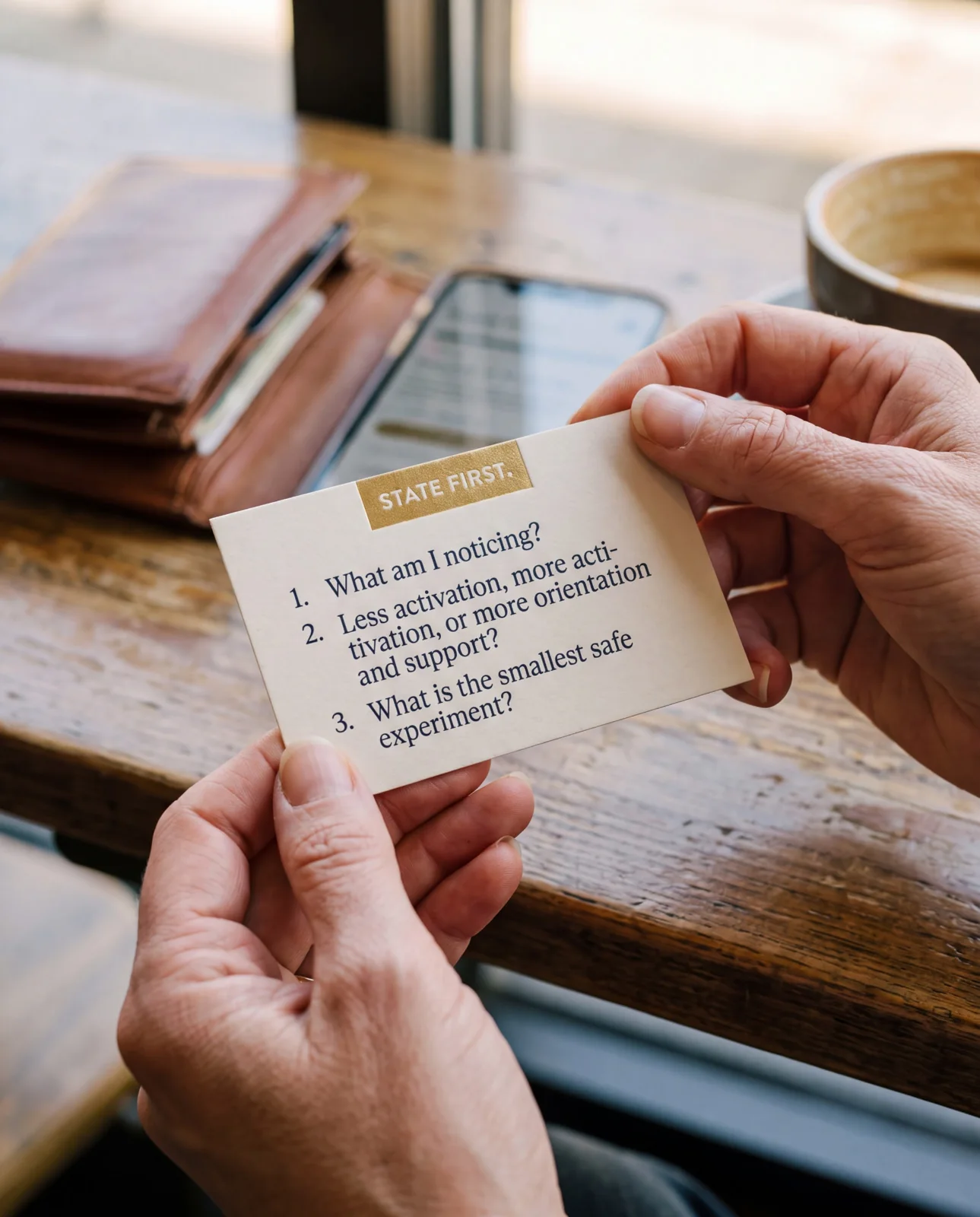
State First.
The 3 Questions
What am I noticing?
Do I need less activation, more activation, or more orientation and support?
What is the smallest safe experiment?
Try Re-check Record
Inside the Workbook

Part 01
Learn the nervous-system concepts you need without turning the workbook into a textbook.
State Map
Part 02
Notice recurring body signals, energy changes, thought patterns, triggers, attention shifts, connection needs and early warning signs.
Pattern Capture
Part 03
Identify people, places, routines, environmental changes and sensory inputs that support you.
Regulation Menus
Part 04
Experiment with practical tools and track what actually changes.
Practice Card
Part 05
Turn what you learn into your own map, menus, Early Warning Plan and Personal Regulation Plan.
Personal Regulation Plan
The Tired-Day Route
Use the short route.
The workbook includes a simplified route for days when energy and attention are limited.
See the Quick Tools
Central Model
60-Second Check-In
Decision Map
Personal Menus
When You Don't Want to Think
Step 0 · Subtract First
Can you turn something down, eat, drink, adjust the environment or step away?
Step 1
What are you noticing?
Aim
Reduce unnecessary intensity
Aim
Gentle manageable mobilization
Aim
Smallest step
Aim
Build capacity for later

Try Re-check Record
This is a decision aid, not medical triage.
Product Preview
What You Receive
The Nervous System Atlas
57 pages · US Letter · A4 · Fillable edition · Tablet edition
Plus · Quick Tools Kit
12 printable reference sheets
Plus · Mobile Reference Wallpapers
2 phone-friendly tools
| Edition | Pages | Use | Format |
|---|---|---|---|
| US Letter | 57 | 8.5 × 11 in | |
| A4 | 57 | 210 × 297 mm | |
| Fillable | 57 | Type into PDF | Digital |
| Tablet | 57 | Digital annotation | Digital |
One Purchase.
Multiple Ways to Use It.
$37 $97
Customer Reviews
★★★★★
4.8 / 5
Customer Rating
2,500+
Customers
The previous version of this product was purchased by customers in the United States, and customer feedback was strongly positive.
Customers valued having a clearer framework for making sense of what they were noticing.
Customers responded positively to having scattered nervous-system information organized into a practical system.
Customers appreciated having exercises and reference tools they could return to when needed.
The state-first approach gave customers a more structured way to decide what to try instead of selecting techniques at random.
The workbook format made it easier to revisit check-ins, maps and exercises rather than treating the material as something to read only once.
Customers found value in noticing recurring signals, patterns and responses.
Customers responded positively to the combination of education, worksheets and practical experimentation.
A major benefit was moving toward a toolkit based on the customer's own observations and responses.
Reviews are published with the reviewer’s permission and reflect individual experiences; results vary from person to person.
Evidence Matters
Soma Atlas Academy separates research findings from clinical frameworks and avoids treating every nervous-system claim as established science.
Strong consistent evidence or basic physiology.
Reasonably good peer-reviewed evidence with limitations.
Promising but preliminary.
A model used in clinical or educational settings that should not automatically be treated as established biological fact.
Polyvagal Theory is discussed as a conceptual and clinical framework where relevant, while ongoing scientific debate is acknowledged.
Our Evidence ApproachEducational Safety
The Nervous System Atlas is an educational resource designed to support self-observation and low-intensity experimentation.
The workbook encourages users to stop any practice that increases distress or concerning physical symptoms and to seek appropriate professional support when needed.
It is not
Who It Is For
You feel wired but tired
You know how to ground but don't always know when to use it
Sometimes you feel revved, other times flat
You understand your patterns intellectually but want something practical
You want more structure than random social-media tips
You want something you can print, fill in and return to

Claire Bennett
Educational Lead, Soma Atlas Academy
Creator of educational tools designed to help people: Notice → Map → Choose → Try → Re-check → Record
Areas of Focus
Who Leads the Education
Claire Bennett develops practical educational resources focused on nervous-system literacy, somatic awareness and structured self-observation.
At Soma Atlas Academy, she works on turning complex concepts around stress, autonomic patterns and regulation into clear frameworks, worksheets and practical tools that can be used in everyday life.
State First. Technique Second.
Rather than presenting regulation as a collection of isolated exercises, her work emphasizes noticing patterns, choosing small experiments and learning from individual responses.
Short CV
Current Role
Leads the development and editorial organization of Soma Atlas Academy's nervous-system education resources, including workbooks, quick-reference tools and guided self-observation materials.
Educational Focus
Nervous-system literacy, autonomic regulation concepts, interoceptive awareness, somatic education and practical behavior-based tools.
Editorial Approach
Translates research and clinical frameworks into accessible consumer education while distinguishing established evidence from emerging research and clinical models.
Special Interests
Learning Library
Practice
A small practice, a clear stopping point and a check-in afterward are more useful than a long list of exercises.
Read Article
Understand
Breath-focused practice is optional. External attention and gentle contact offer other starting points for self-observation.
Read Article
Map
Organize observations into a short, revisable plan: early signals, supportive conditions and small experiments.
Read ArticleFAQ
Last updated: October 7, 2026
The Nervous System Atlas in US Letter, A4, fillable and tablet-friendly formats, plus the 12-sheet Quick Tools Kit and two mobile reference wallpapers.
No. This is a digital product. Printable versions are included so you can print the pages you want.
Yes. A tablet-friendly edition is included.
Yes. A fillable edition is included.
No. The workbook explains the concepts needed to use the system and also distinguishes clinical frameworks from established physiology.
No. It is an educational resource and does not replace medical or mental-health care.
No. The workbook uses working labels for self-observation. They are not diagnoses or physiological measurements.
No. There is a full learning route and a shorter tired-day route for times when energy or attention are limited.
Instant digital access after purchase.
14-day money-back guarantee on the main $37 bundle. Request a refund within 14 days of purchase. Additional products and offers are excluded, except where applicable law requires otherwise. Contact productadvice.info@gmail.com with your full name and purchase email. Read the full refund policy.
Notice what is happening.
Choose a small experiment.
Learn what works for you.
State First. Technique Second.